History of Saree Draping
“Unlock the Timeless Art of Saree Draping – Experience the Rich History of India!
Because Saree has been a Civilizational Garment, not only a fashion object.”
Overview
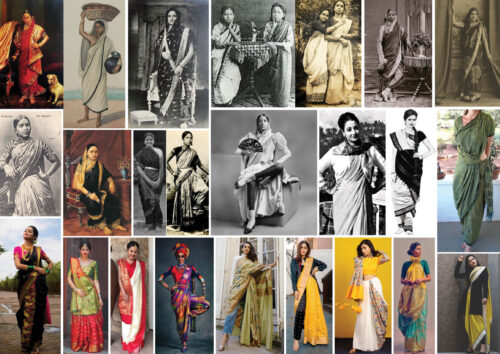
The saree stands as one of the world’s oldest, continuously worn unstitched garments. Across five millennia, it has adapted to climate, labour, religious symbolism, ritual architecture, political change, trade patterns, textile technology, and evolving ideas of identity. Unlike stitched garments that evolve through tailoring, the saree evolves through textile refinement and draping logic—making it a rare example of civilizational continuity embedded within cloth.
This article traces that evolution through precise eras, integrating textile production, community structures, draping engineering, political events, and climate-driven adaptations, supported by visual diagram-style references.
We will read about The Evolution of Saree Draping Styles Through the Ages, Exploring the Different Regional Variations of Saree Draping and Top Saree Drapers Of India….

The Evolution of Saree Draping Styles Through the Ages
The saree is “A Timeless Garment” that has been around for centuries, and its draping style has evolved over the years. From the traditional pleats and pallu of the past to the modern-day drapes and twists, the saree has come a long way. So the History of Saree Draping is made of.

Over five millennia, the saree has evolved through technology, climate logic, ritual meaning, social structure, political upheaval, and individual creativity, yet it remains fundamentally unstitched. Its power lies in its adaptability: when materials change, draping changes; when society transforms, silhouette transforms. The saree is thus not just clothing—it is one of India’s most enduring expressions of civilizational intelligence.
1. INDUS VALLEY CIVILIZATION (c. 2800–1800 BCE)
Era Overview
The Indus Valley Civilization developed the first organized cotton economy, with cities containing structured craft zones, drainage systems supporting dyeing pits, standardized spindles, and active port trade. Textile activity flourished due to surplus agriculture, allowing specialization in spinning, dyeing, weaving, beadwork, and finishing. Clothing was functional, climate-responsive, and socially uniform—prioritizing mobility and heat regulation.


Textile Production
- Domesticated cotton; spindle whorls; simple looms
- Mineral and plant dyes
- River-washed, sun-dried finishing processes

Draping relied on simple wrapping, friction, and body movement. No pleats or pallu existed; fabric followed natural contours, offering ventilation and ease during labour.
Draping Logic
- A wrapped lower garment held by tension, not knots
- No structured pleats; natural folds created shape
- Upper cloth optional depending on weather and tasks
- Purely functional geometry based on movement
Measurements
- 2.5–4 yards; 24–36 inches width
Communities & Workers
- Non-caste urban craft groups
- Women spin; men weave
Major Events
- Cotton domestication
- Mesopotamian trade
- Expansion of craft workshops
2. VEDIC & POST-VEDIC ERA (1500–500 BCE)
Era Overview
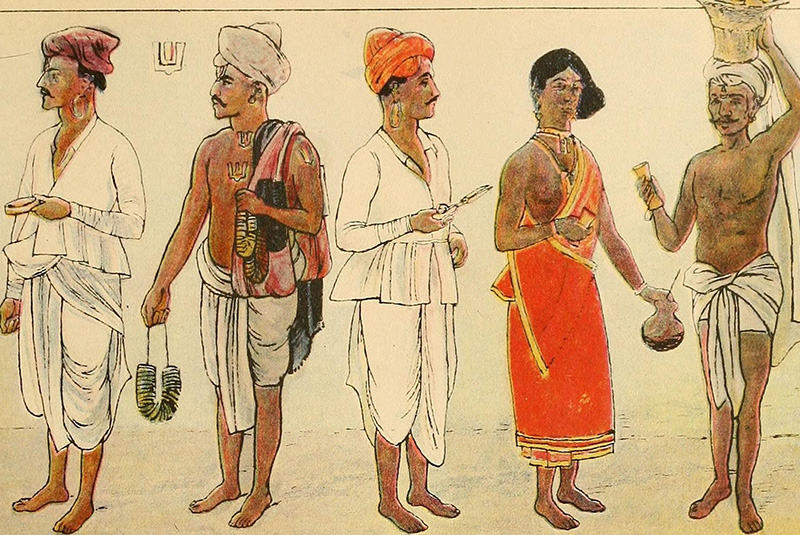
This era integrated clothing deeply into ritual, purity, hierarchy, and lifestyle. The tripartite garment system—antariya, uttariya, stanapatta—became the conceptual skeleton of saree draping. Expanding agriculture supported widespread cotton availability, and regional trade began shaping dye practices.
Textile Production
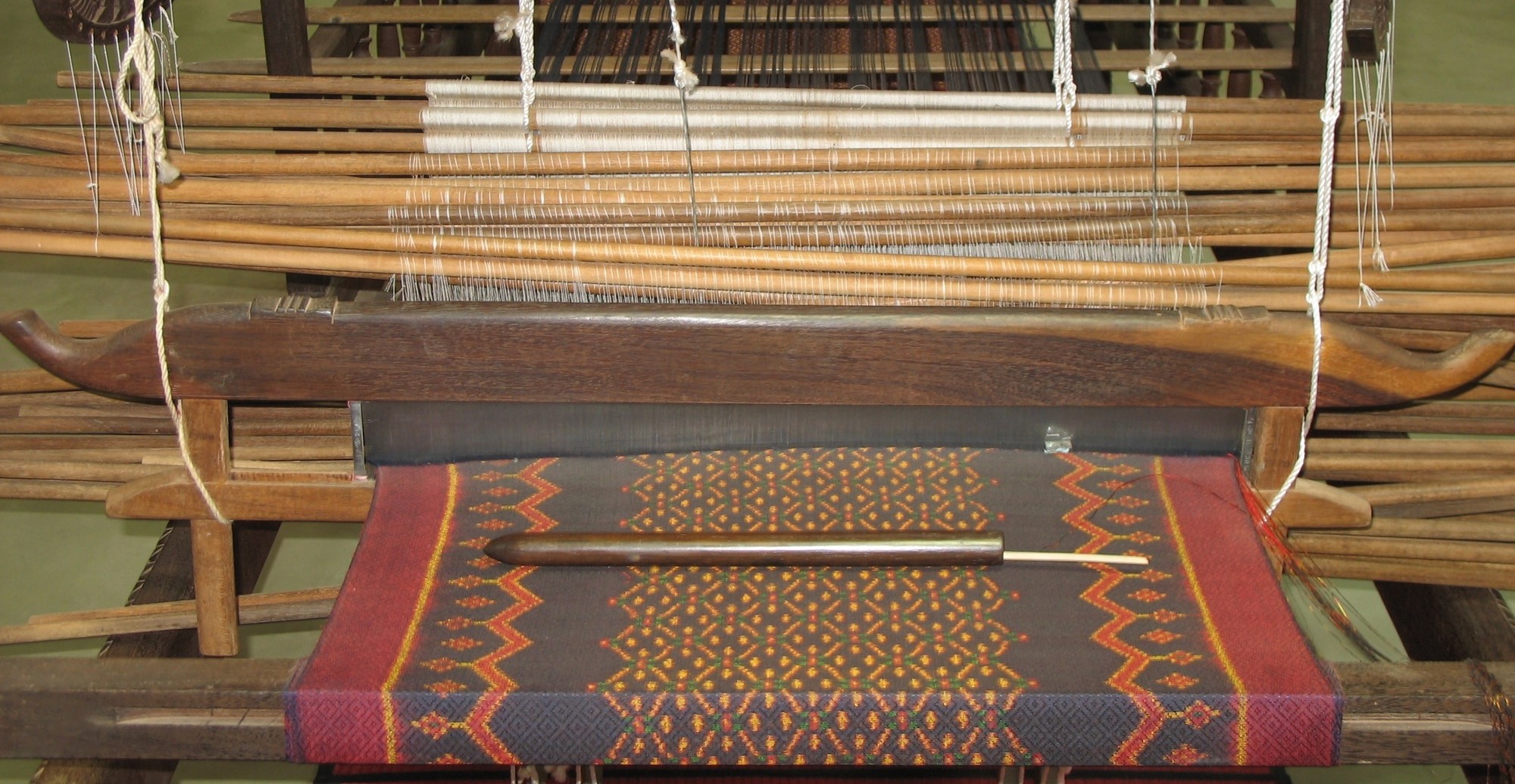
- Improved spinning
- Turmeric, madder, indigo dyes
- Upright looms for broader cloth

Birth of Layered Draping
The antariya provided foundational lower drape structure; the uttariya acted as an early pallu. Draping followed ritual codes, combining modesty with mobility.

The Evolution of Saree Draping Styles Through the Ages
- Antariya becomes early saree-like lower wrap
- Uttariya becomes functional shoulder drape
- Layering controls modesty, purity, and priestly conduct
- Structural logic moves from survival to ritual meaning

Measurements
- 3–5 yards; 30–40 inches width
Communities & Workers
- Household weaving economies
- “Vayakara” references appear
Major Events
- Ritualization of dress
- Early guild formation
- Dye-market growth
3. MAURYA & GUPTA ERA (322 BCE – 550 CE)
Era Overview
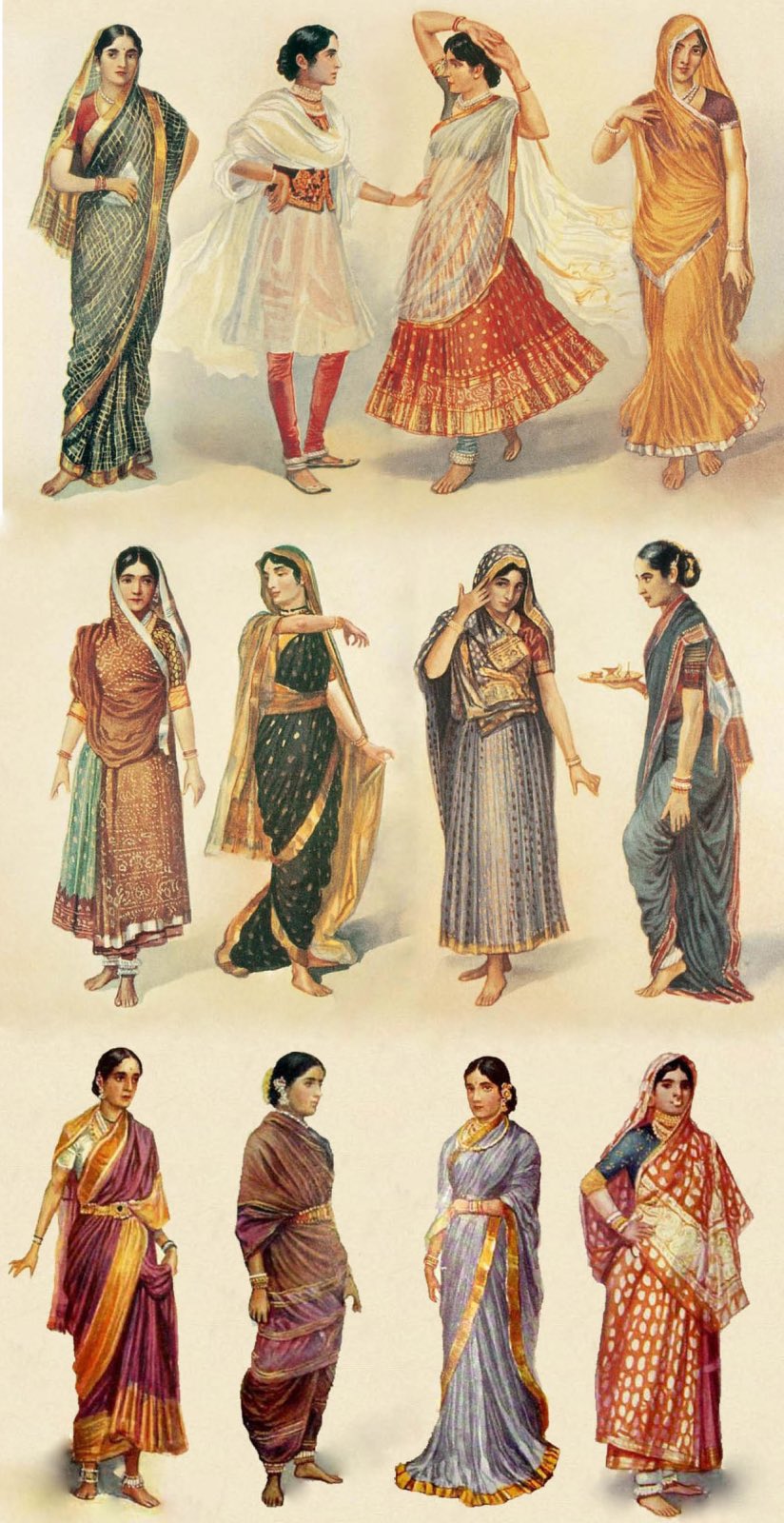
A classical golden age where textile guilds formalized production. Bengal muslin reached remarkable fineness; silk entered mainstream use; cities flourished as textile hubs. International trade with Rome and Central Asia elevated Indian textiles. Draping became elegant, structured, and deliberately engineered.
Textile Production
- Muslin, early silks, woven borders
- Multi-shaft looms
- Mordant dyeing and polishing
Introduction of Pleats
Pleats stabilized the garment, enabling graceful fall and symmetrical draping. The pallu became a defined extension for modesty and ornamentation.

Draping Logic
- Pleats introduced for stability and shape
- Pallu becomes visual & functional accent
- Draping follows geometric anchors: waist, hip, shoulder
- Saree becomes both functional and court-appropriate
Measurements
- 4.5–6 yards; 36–44 inches
Communities
- Guild artisans: tantuvaya, sauvika
Major Events
- Roman trade
- Silk Road influence
- Sculptural documentation
4. EARLY MEDIEVAL ERA (600–1000 CE)
Era Overview
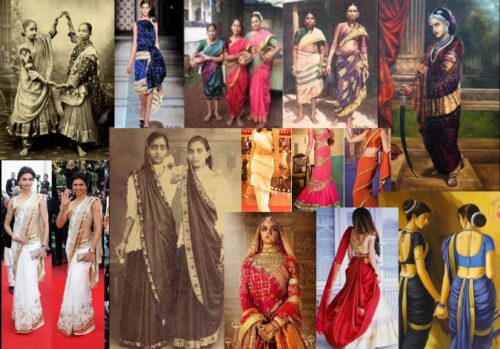
Regional kingdoms create local textile identities. Temple economies expand, demanding specific ritual drapes. Maritime trade introduces new dye sources. Weaving castes form. Draping evolves into occupationally adaptive styles.
Textile Production
- Mulberry silk; cotton; ikat development
- Community dye yards

Climate & Labour Engineering
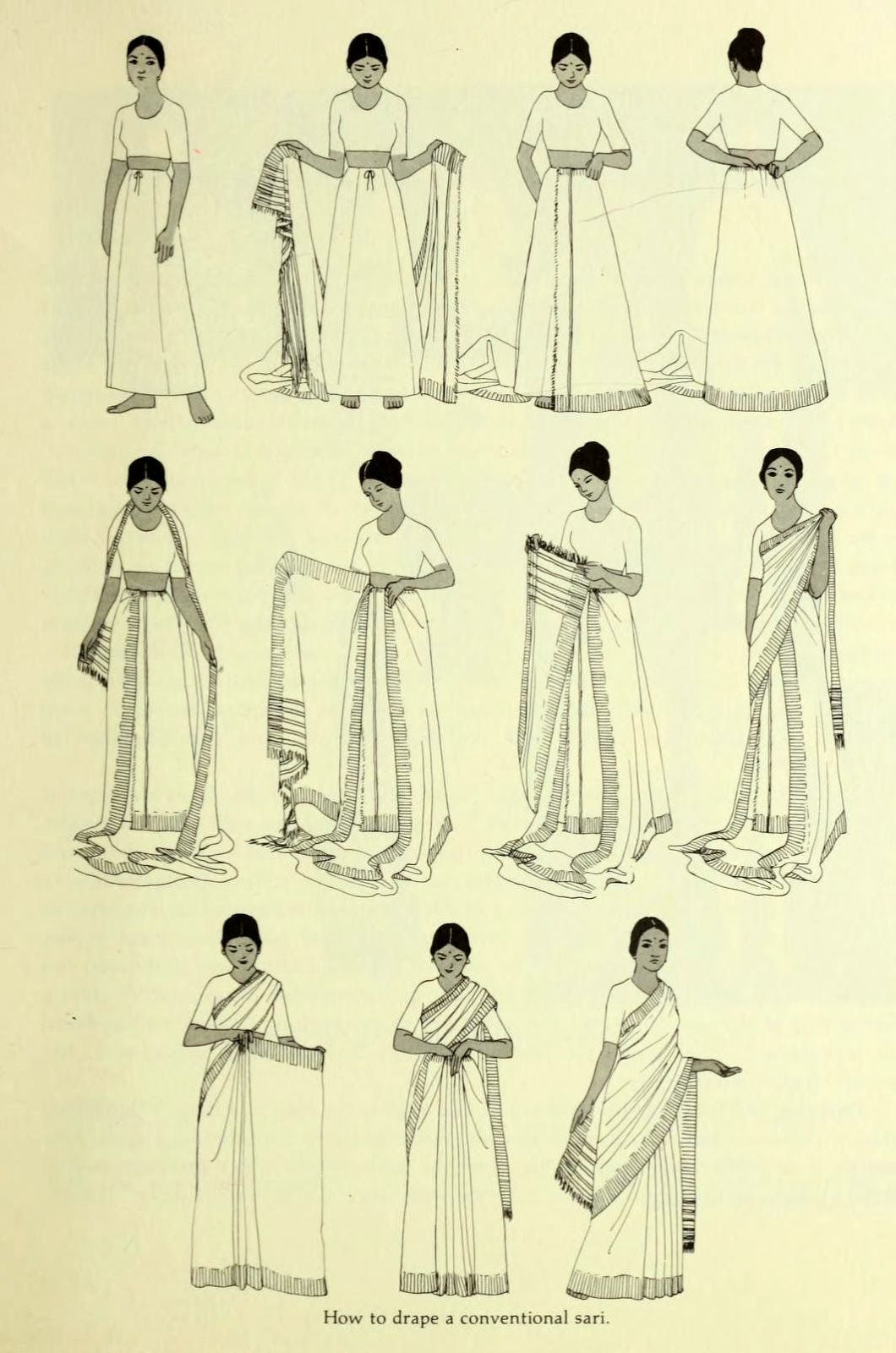
Kaccha drapes support physical work; short pallus prevent obstruction; loose pleats respond to humidity. Draping becomes adaptive to occupation and environment.
Draping Logic
- Kaccha drapes for labour, dance, and mobility
- Climate-influenced tight/loose draping
- Region-specific movement engineering
Measurements
- 5–7 yards; 40–45 inches
Communities
- Devanga, Koshti, Patwa, Salvi
Major Events
- Temple patronage
- Arab maritime trade
- Regional craft clustering
5. HIGH MEDIEVAL ERA (1000–1600 CE)
Era Overview
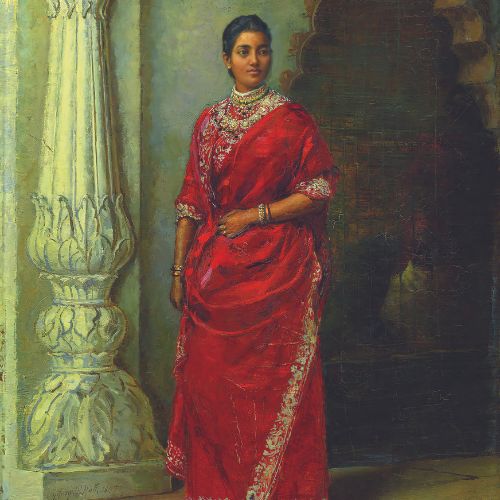
This is the age of culturally iconic drapes. Courts and temples produce brocades, silk, patola, jamdani. Regional saree identities flourish. Indo-Persian aesthetics influence motifs. Drapes become visually codified: Nauvari, Madisar, Athpoure, Nivi.
Textile Production
- Zari brocade, double ikat, jamdani
- Heavy borders; temple motifs
Iconic Regional Drapes
Each drape solves a unique functional need: Nauvari for mobility, Madisar for ritual, Athpoure for climate, Nivi for elegance. This era forms India’s drape identity map.
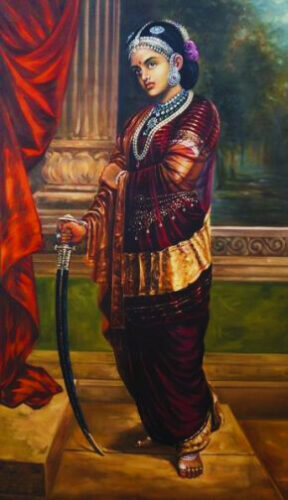
gracing the Nauvari Saree

Draping Logic
- Mobility-driven Nauvari
- Ritual-layered Madisar
- Climate-responsive Athpoure
- Balanced Nivi
Measurements
- 6–9 yards
Communities
- Padma Sali, Kaikolar, Tanti, Pattusali, Julaha
Major Events
- Chola/Vijayanagara patronage
- Mughal textile refinement
- Temple festivals
6. COLONIAL ERA (1700–1947)
Era Overview
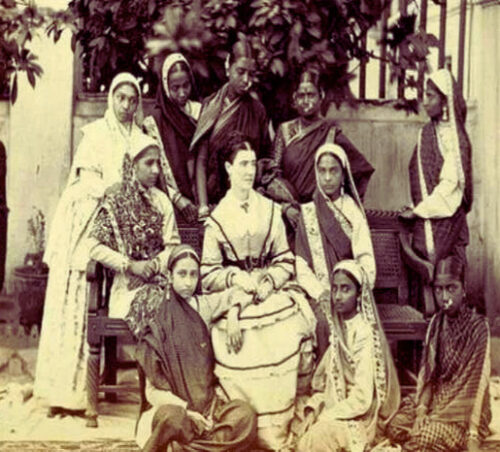
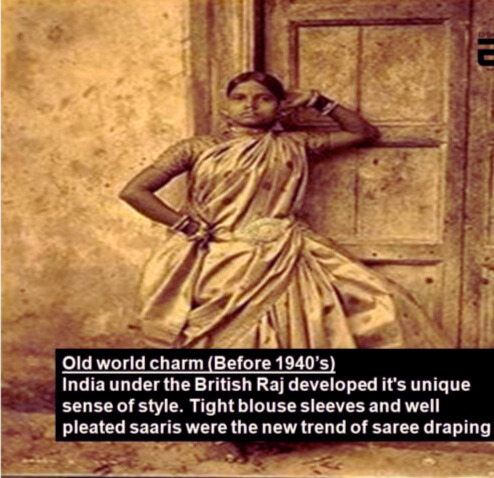
Industrial imports collapse local spinning and weaving. New moral codes reshape saree structure: blouses, petticoats, pins. Saree becomes political attire during Swadeshi protests.
Textile Production
- Mill cloth; chemical dyes
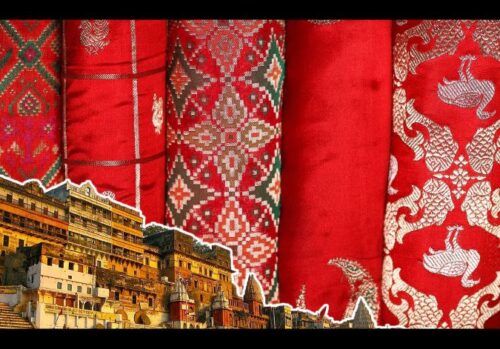
Structural Modernization of Saree
Blouses and petticoats create stitched foundations beneath the drape. Pins standardize the pallu. The Nivi drape becomes a national symbol through photography and painting.

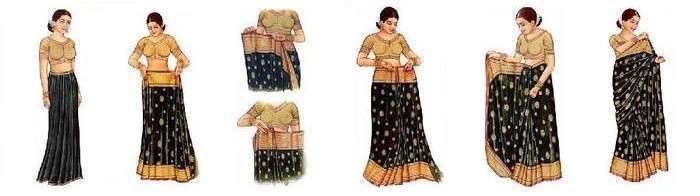
Draping Logic
- Blouse + petticoat integration
- Pinned pallu
- Standardized pleats
Major Events
- Swadeshi movement
- Weaving decline
- Rise of printed sarees
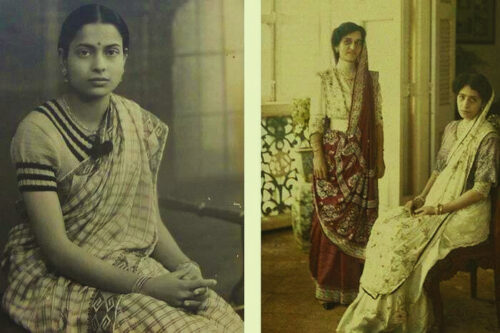
7. POST-INDEPENDENCE ERA (1947–1990)
Era Overview
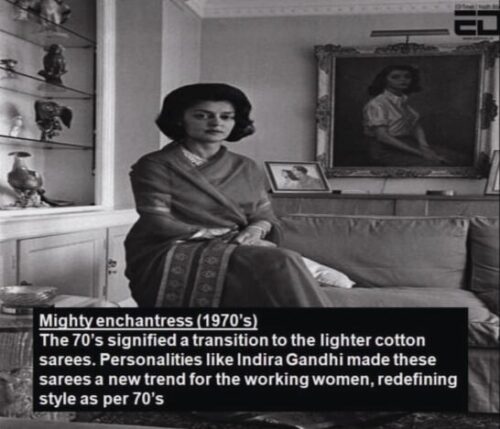
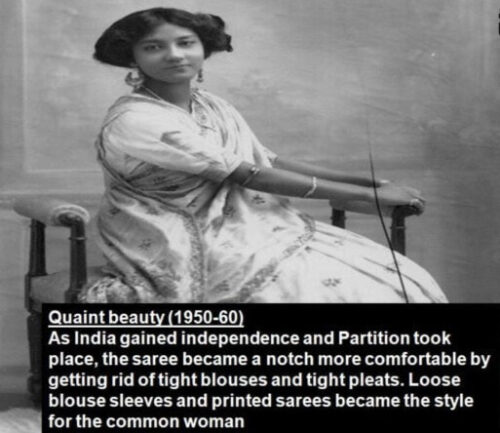
India rebuilds textile heritage through institutions, cooperatives, and national identity building. Saree becomes a modern working garment and ceremonial cultural anchor.
Textile Production
- Revival of handloom clusters
- Sericulture development
Draping Logic
- 6-yard standardized drape for functionality
- Regional drapes preserved through festivals
- Cinema influences silhouette
Measurements
- 5.5–6 yards
Major Events
- Handloom Board
- Weaver Service Centres
- Export diversification
8. CONTEMPORARY ERA (1990–Present)
Era Overview
Digital platforms, global fashion weeks, sustainability, and designer innovation expand saree identity into couture, workwear, gender-fluid fashion, and heritage revival.
Textile Production
- Bamboo, banana, lotus fibres
- Digital printing
Modern Fusion & Functional Drapes
Pre-stitched pleats save time; pant-sarees enhance movement; jacket pallus add structure; gender-neutral drapes expand expression. Tradition meets contemporary engineering.

Draping Logic
- Pre-stitched sarees
- Pant drapes
- Jacket pallus
- Gender-neutral forms
Major Events
- GI-tag boom
- Global runway presence
- Social-media-driven revival
Exploring the Different Regional Variations of Saree Draping
There are many ways to drape a saree or should say “The 6 yard Beauty“. Few and most common of them are given below in “Exploring the Different Regional Variations of Saree Draping”.
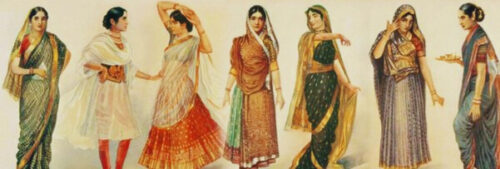
There are more than 60 to 80 regional drapes from about 15 states. When it comes to History of Saree Draping, there are many regional variations that can be explored. From the traditional Gujarati style to the more modern Bengali style, each region has its own unique way of draping a saree. Let’s take a look at some of the different regional variations of saree draping.
Here we have few Major regional Variation And How It is Drapped:
Gujarati style
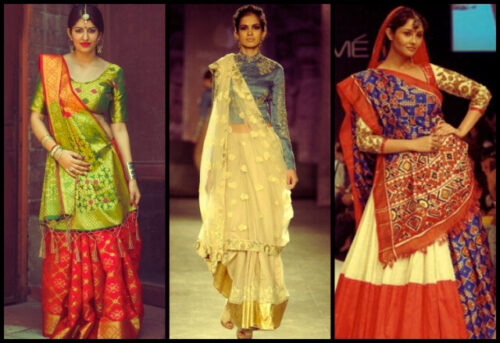
This saree draping is one of the most popular styles in India from Gujarat. It is characterized by a pleated pallu that is draped over the shoulder and a pleated skirt that is tucked into the waist. This style is usually worn with a blouse and a dupatta.
Bengali style from Bengal
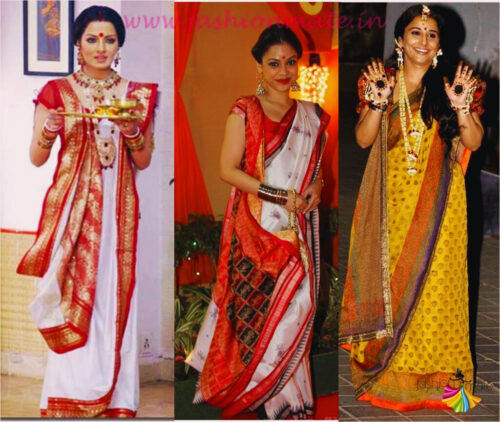
A bit more traditional. It is characterized by a pleated pallu that is draped over the shoulder and a pleated skirt, tucked into the waist. This style is usually worn with a blouse and a dupatta. The pallu is usually draped in a way that it covers the entire back and is usually decorated with intricate embroidery.
Marwari Style- Rajasthan
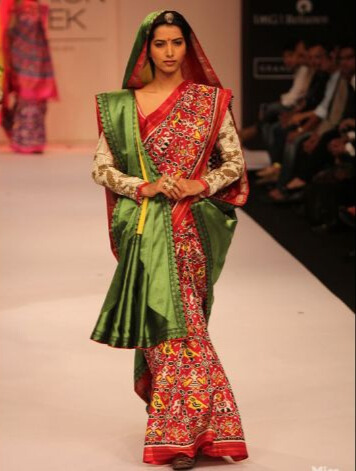
The draping is a bit more modern. It is characterized by a pleated pallu that is draped over the shoulder and a pleated skirt that is tucked into the waist. This style is usually worn with a blouse and ocassionaly with dupatta. The pallu is usually draped in a way that it covers the entire back.
Maharashtra region-
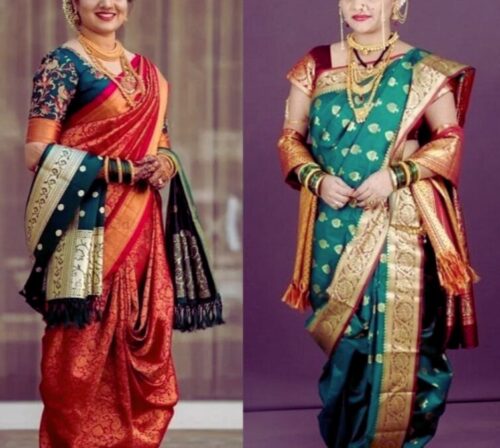
The Maharashtra style of saree draping, also known as the Nauvari style. The name derives by the 9 meter length of the Saree. One of the most Iconic and popular darpe in Maharashtra.
Nauvari has a unique way of draping the saree that originated in the state of Maharashtra, India. Unlike many other styles of saree draping, the Nauvari technique involves passing the saree between the legs and then tying it securely at the waist. As a result, it creates a comfortable and practical drape that allows greater ease of movement.
Furthermore, the remaining fabric is carefully arranged and draped over the shoulder, thereby highlighting the intricacies of the saree’s design. Consequently, this style not only enhances functionality but also brings out the beauty of traditional craftsmanship.
Authentic Maharashtra Saree-Draping Styles:
- Nauvari Kashta Style
- Brahmani (Brahmin) Nauvari Style
- Peshwai Style
- Kolhapuri Nauvari Style
- Lavani Dance Style
- Koli Saree Draping Style
- Pathare Prabhu Draping Style
- Vidarbha (Kalpati) Nauvari Style
- Puneri Nauvari Style
- Maratha Warrior Style (Veerangana Nauvari)
The Maharashtra style of saree draping is often seen as a symbol of empowerment. And independence for women, and it is a popular choice for traditional Maharashtrian weddings and other cultural events.
North Style
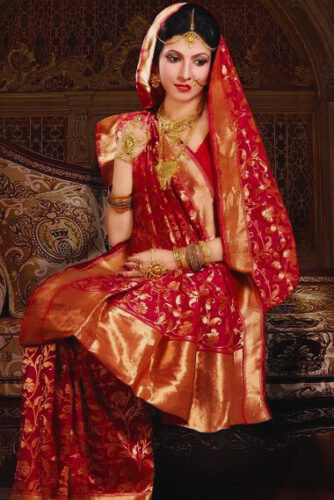
North Indian Saree Draping Styles:
Known for its simplicity and ease of wear. It involves draping the saree around the waist and over the left shoulder, with the pallu (the loose end) covering the head and flowing down the back. The saree is usually pleated at the front; however, the number of pleats and the width of those pleats may vary depending on the wearer’s preference. Moreover, different regional traditions often influence how these pleats are arranged, adding subtle variations to the overall look. This style is popular in northern India and is often worn with a long-sleeved blouse and traditional jewelry.
1. Seedha Pallu Drape – Uttar Pradesh & Parts of North India:
A six-yard saree worn with the pallu brought to the front over the shoulder. Highlights borders and allows modesty. Common with Banarasi sarees.
2. Ulta Pallu Drape – Bihar
The pallu comes from back to front on the right side. Functional, secure, and suited for daily movement. Works well with Tussar sarees.
3. Gudiya Style / Rural Wrap – Uttar Pradesh & BiharA simple, tight rural wrap with minimal pleats and a firmly tucked pallu. Practical and work-oriented.
4. Tribal Short Drape – Jharkhand
A shorter saree worn without a petticoat, wrapped tightly for mobility. Pallu often tucked or tied. Seen in Santhal and Munda communities.
5. Pahari Drape – Himachal Pradesh
A compact saree wrap paired with wool shawls instead of a flowing pallu. Designed for cold climates and mountain mobility.
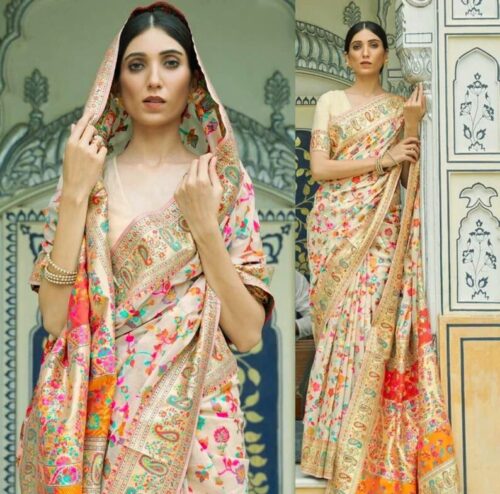
6. Kashmiri Minimal Drape – Jammu & Kashmir
The saree is draped simply, often under a pheran, with minimal pleating. Practical for winter layering rather than display.
7. Urban North Nivi Hybrid – Delhi & Metro Cities
A structured version of the Nivi drape with crisp pleats and a neatly pressed pallu. Popular in workplaces, events, and modern styling.
Karnataka Region
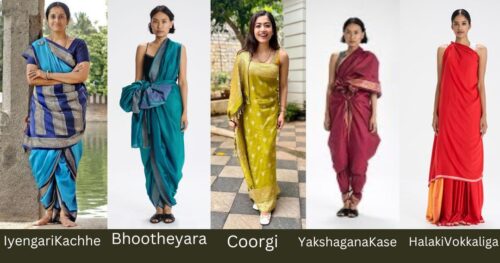
In Karnataka alone which is known to be the fulcrum of silk and hence one of the largest producers of silk sarees.
There are more than 9 to 10 varieties of documented drapes that belongs to Karnataka.
They are IyengariKachhe, Bhootheyara, Mysore Shaili, Coorgi, YakshaganaKase, HalakiVokkaliga.
Tamil Style
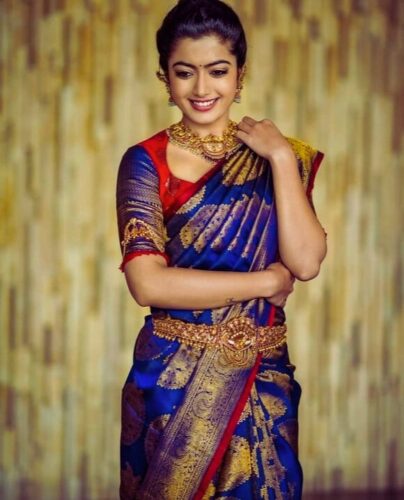
Tamil Nadu’s saree drapes reflect temple traditions, classical dance culture, Dravidian heritage, and region-specific customs across Chennai, Madurai, Coimbatore, Tirunelveli, and Kongu regions.
Here are the key drapes of Tamil-
1. Madisar (Iyer & Iyengar Brahmin Communities – Tamil Nadu)
A 9-yard saree draped without a petticoat, forming a dhoti-like lower half and pleated upper wrap. Worn during weddings, rituals, and festivals by Tamil Brahmin women, symbolizing purity and tradition.
2. Kandaangi Drape (Chettinad Region – Karaikudi & Sivaganga)
A traditional drape for heavy Chettinad sarees, tied tightly with fewer pleats and a short front length. It allows easy movement and is commonly worn during Chettinad weddings, rituals, and cultural celebrations.
3. Pudavai Kaatchi Drape (Tanjore & Cauvery Delta Region)
A drape emphasizing long, flowing pallus to showcase intricate silk patterns. Popular with Kanchipuram and Tanjore silks, especially during temple visits, classical music events, and formal family functions in the Tanjavur belt.
4. Kongu Style Drape (Coimbatore, Erode & Tiruppur)
A practical drape from the Kongu region, featuring a shorter pallu tucked tightly to avoid slipping. Common among working women for convenience during farming, weaving, and daily household activities across western Tamil Nadu.
5. Veshti Pudavai Drape (Tirunelveli & Southern Tamil Nadu)
A simple drape where the lower half resembles a veshti, providing comfort in the warm southern climate. Often worn by elderly women and during traditional ceremonies in Tirunelveli, Tuticorin, and nearby regions.
6. Bharatanatyam Dance Drape (Statewide Classical Tradition)
A stitched or pre-pleated drape mimicking the Madisar style but adapted for movement. Used by Bharatanatyam dancers for performances, temple festivals, and cultural showcases across Tamil Nadu.
Mundum Neriyatum–Kerala
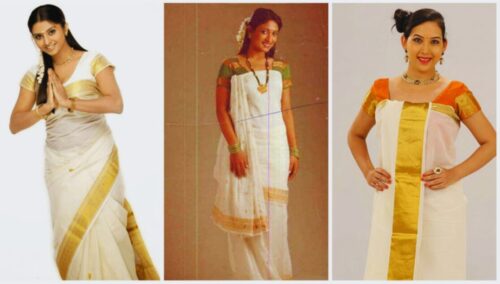
The traditional clothing of women in Kerala, a state in southwestern India. It is the oldest remnant of the ancient form of the sari which covered only the lower part of the body. In the mundum neriyatum, the most basic traditional piece is the mundu or lower garment which is the ancient form of the sari denoted in Malayalam as tuṇi (meaning cloth), while the nēriyatu forms the upper garment the mundu.
The mundum neriyatum consists of two pieces of cloth, and could be worn in either the traditional style with the nēriyatu tucked inside the blouse, or in the modern style with the nēriyatu worn over the left shoulder.
Andhra Pradesh
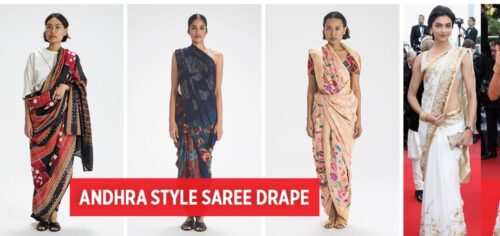
Andhra Pradesh preserves diverse saree draping traditions shaped by its coastal, Rayalaseema, and rural cultures, reflecting community practices, temple customs, and age-old Telugu heritage.
1. Nivi Drape (Andhra Coastal & Urban Regions)
A classic Telugu drape where the saree is wrapped right to left, front pleats centered, and pallu rests on the left shoulder. Popular across coastal Andhra cities for daily wear, ceremonies, and festivals.
2. Kappulu Drape (Traditional Rural Andhra)
An older village-style drape seen in rural Andhra communities. Saree wraps left to right, creating fuller coverage with pallu on the right shoulder. Worn for cultural rituals, heritage celebrations, and traditional gatherings.
3. Gochi Kattu (Rayalaseema & Telangana-Adjacent Areas)
A functional drape secured with a waist knot called “gochi.” Lower pleats may shift sideways. Traditionally worn by women in Rayalaseema for mobility during agricultural, household, and outdoor activities.
4. Gudakattu / Guda Kattu (Andhra Brahmin Households)
A nine-yard saree draped dhoti-style without a petticoat, mainly used in Andhra Brahmin rituals. The saree passes between the legs and symbolizes ceremonial purity during religious functions and marriage rites.
5. Langa Voni / Half-Saree (Statewide Telugu Tradition)
Traditional attire for young girls throughout Andhra. Includes a long skirt, blouse, and Voni draped over the shoulder. Worn during puberty rituals, festivals, weddings, and pre-bridal ceremonies representing cultural transition.
Telangana
Telangana’s saree drapes reflect its Deccan culture, tribal influences, rural traditions, and distinct weaving heritage, especially across Warangal, Karimnagar, Nalgonda, and Hyderabad regions.
1. Telangana Nizam Style Drape (Hyderabad & Surrounding Areas)
Influenced by the Nizam era, this drape features a neatly pleated saree with an elegant, flowing pallu. Popular among urban Telangana women, it blends traditional Telugu aesthetics with Hyderabadi royal grace and sophistication.
2. Ganga Jamuna Style Drape (Warangal & Karimnagar Region)
A traditional drape paired with two-tone borders symbolizing Ganga–Jamuna tradition. Saree is pinned neatly with a structured pallu. Common during festivals, temple visits, and special events in northern Telangana households.
3. Gochi Kattu (South Telangana & Rural Belts)
A practical rural drape where the saree is secured at the waist with a knot called “gochi.” Allows free movement for farming, household work, and travel, widely seen in villages near Nagarkurnool and Wanaparthy.
4. Lambadi / Banjara Drape (Tribal Telangana – Adilabad & Khammam
A colorful tribal drape worn by the Lambadi/Banjara community. Saree is wrapped tightly with minimal pleats, supporting heavy embroidered blouses and accessories. Common during dances, festivals, and cultural performances in tribal belts.
5. Seedhari / Simple Telugu Drape (Statewide Telangana)
A straightforward, everyday drape used by older women across Telangana. Minimal pleats, pallu loosely placed, emphasizing comfort over style. Common in semi-urban and rural households for routine chores and casual wear.
Odisha
Odisha’s saree drapes reflect ancient temple traditions, tribal culture, and coastal heritage, especially across Puri, Cuttack, Ganjam, Sambalpur, and Mayurbhanj regions.
The six drapes from Odisha include:
1. Odia Kachela Style (Coastal Odisha – Puri & Cuttack)
A traditional Odia drape using a tucked-back portion called kachela for secure movement. Common among married women during temple visits, rituals, and daily chores in coastal regions, emphasizing practicality and modesty.
2. Nabakothi Drape (Central Odisha – Cuttack & Khurda)
Worn mainly with Nabakothi sarees featuring symbolic motifs. The drape maintains crisp pleats and a neatly placed pallu, suitable for cultural ceremonies, festive occasions, and traditional household events across central Odisha communities.
3. Sambalpuri Drape (Western Odisha – Sambalpur, Bargarh)
A structured drape used with heavy ikat Sambalpuri sarees. The pallu is thrown firmly over the shoulder to highlight weaving patterns. Popular during festivals, weddings, and cultural gatherings across western Odisha districts.
4. Ganjam Drape (Southern Odisha – Berhampur & Ganjam)
A traditional southern Odia style featuring tighter wrapping and broader pleats to secure the saree. Usually worn with Berhampuri Patta sarees during weddings, temple rituals, and community celebrations in Ganjam and nearby areas.
5. Santhali Tribal Drape (Northern Odisha – Mayurbhanj & Keonjhar)
A shorter tribal-style drape worn by Santhal women, wrapped above the ankles for easy movement. Practical for dance, agriculture, and daily life, commonly seen in northern Odisha’s tribal belts.
No matter which regional variation of saree draping you choose, you can be sure that you will look stunning! So, go ahead and explore the different regional variations of saree draping and find the one that suits you best. Who knows, you might even find a new favorite style!
The Revival of Traditional Saree Draping Styles in Modern Times
In modern times, it often seems as though the traditional saree draping styles of India have been forgotten. However, in recent years, there has been a noticeable revival of these age-old styles.
Moreover, this resurgence comes with a refreshing modern twist, allowing contemporary wearers to celebrate heritage while embracing present-day fashion sensibilities.”
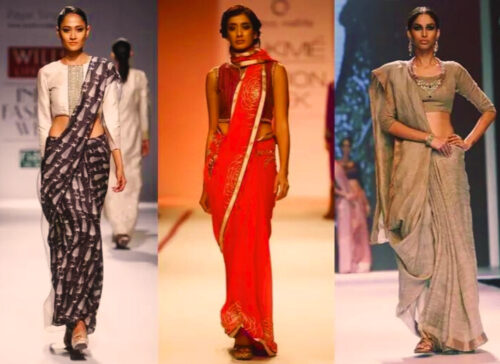
Gone are the days when the saree was just a plain piece of cloth draped around the body. Now, it is a fashion statement. From the traditional Nivi style to the more modern Lehenga style. There is something for everyone.
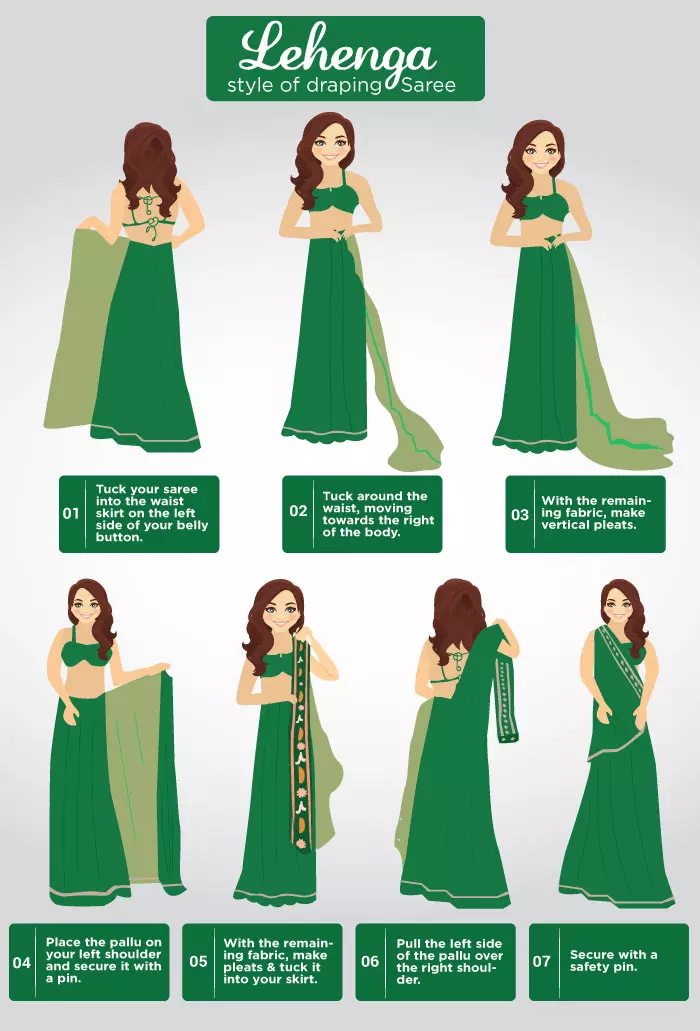
Lehenga style
The Lehenga style is a more modern take on the traditional saree draping style. It is a combination of the Nivi style and the traditional Lehenga style. It is perfect for those who want to make a statement with their saree.
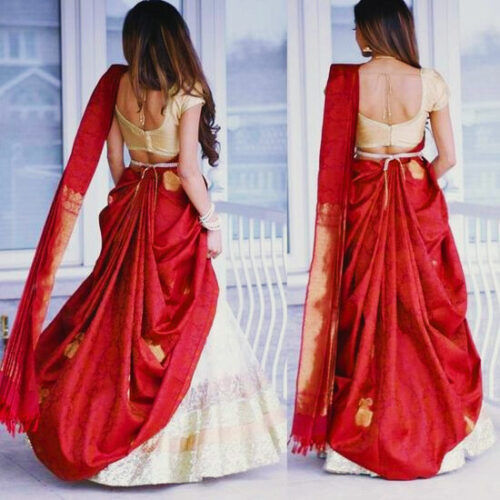
Butterfly style
This one is a kind of lahanga style. Majorly the dupatta drapes like butterfly wings by pleating and tucking on the backside of waist.The bottom side of dupatta than get spread following by Lehanga width.
Fusion Style Drapes
“A mix of Tradition and Modern drapes.”
This style of draping is most popular in modern time.
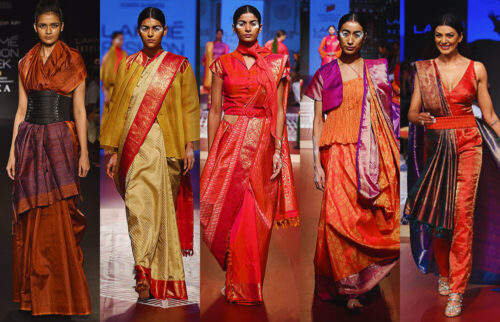
- The Dhoti style is another modern take on the traditional saree draping style. It is a combination of the Nivi style and the traditional Dhoti style.
- Another is Pant Style Drape which is a touch with western paired with Pant and wrapping Half Saree style showing-off pant.
- Next is Saree with Belt Draping, one of inspired from traditional gold, pearl or silver belts. It is being used from ancient times, fusioned with modern belts made of leather or fabric and other materials.
- Another one is with Jacket, it could be embroidery, solid or any patterns from short to long. This can be wear above the saree pallu or inside it.
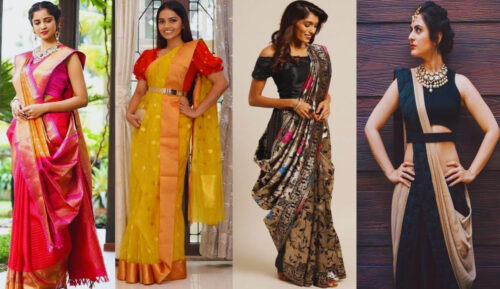
Half-Saree style
A combination of the Nivi style and the traditional Half-Saree style. It is perfect for those who want to look stylish and comfortable at the same time.
Nivi style
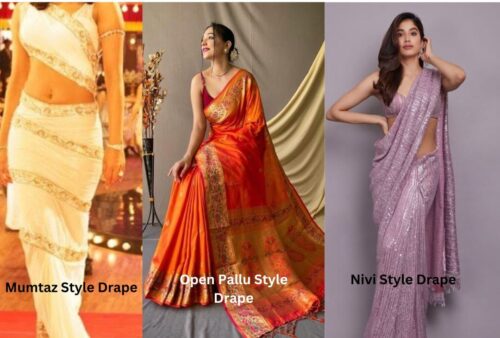
The Nivi style is the most popular and traditional way of draping a saree. It is a simple yet elegant style that is perfect for formal occasions. It is also the most comfortable way to wear a saree.

The Bollywood style
- The Bollywood style is a combination of the Nivi style and the traditional Bollywood style. It is perfect for those who want to look glamorous and stylish at the same time.
- Mumtaz Style drape is one which came from bollywood from the era of 70’s. It got it went viral becoz of bollywood star Mumtaz Askari madhvani.
- One is Open Pallu Drape from very old eras but again can be said populared by bollywood.
Mermaid Drape
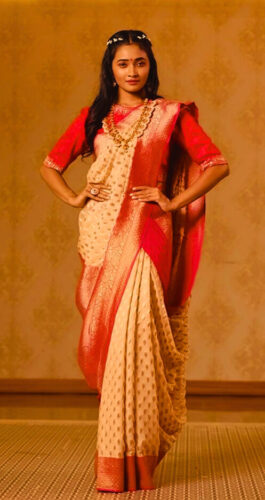
One of awsome drapes that I found and become my favourite too.. Platting style is similar to Nivi style and pallu draping is followed like Lehanga pallu.
Important tips for draping:
- Avoid wearing satin petticoats as they tend to cling and cause static. Opt for mulmul fabric instead. In case you must use satin, ensure to wear a light mulmul layer underneath to prevent static issues.
- Prior to using a safety pin on your sari, consider inserting a small bead or pearl first. This simple trick will prevent your sari from getting entangled in the coil section of the pin and avoid tearing.
- Always ensure that your petticoat is shorter than your sari’s length to avoid any peeking out when you walk or sit down. This will maintain a neat and elegant appearance.
- To give it a flair lehenga look wear can-can petticoat underneath or simply add can can flair to your existing one.
- For a slim Saree look like Nivi style wear Slim and stretchable petticoat. It is available at many Online and offline stores as well.
No matter what style you choose, you can be sure that you will look stunning in your saree. So, go ahead and embrace the revival of traditional saree draping styles in modern times!
Top Saree Drapers Of India….
Here we have few most popular saree drapers from India:
- Dolly Jain
- Kalpana Shah
- Gaurav Gupta
- Sabyasachi Mukherjee
- Ritu Kumar
- Abu Jani & Sandeep Khosla
- Gaurang Shah
- Raw Mango (Sanjay Garg)
- Pleats by Aruni
- Anavila Misra
- Rimzim Dadu
- Tarun Tahiliani
Know More about these drapers……..

The saree draping styles have evolved over time, reflecting changes in culture, tradition, and fashion. Despite these changes, the saree remains an iconic and timeless garment that continues to be worn by women across India and the world.


Pingback: Banarasi Silk Saree - A Luxury - Guisegarner.com
nice info